
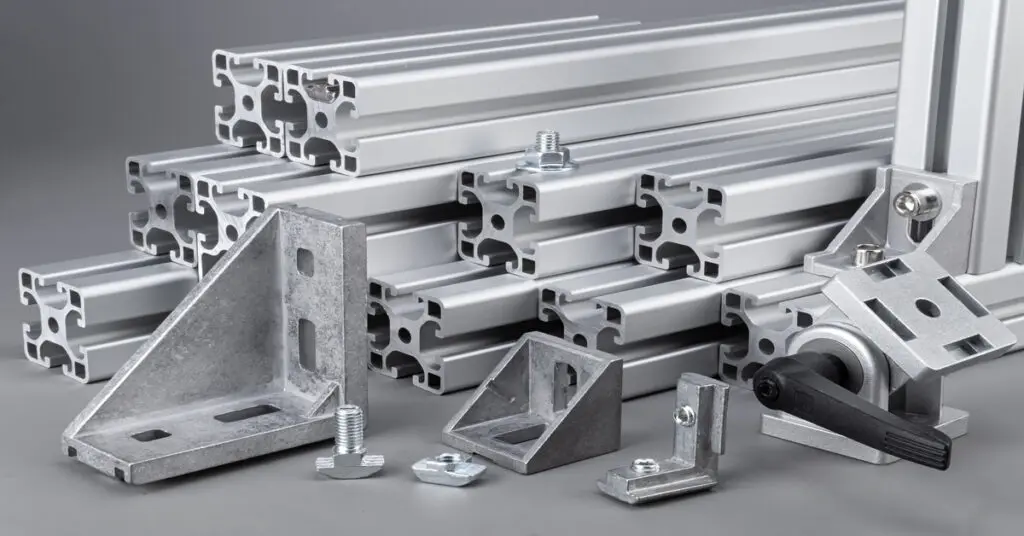
Automation cells are becoming increasingly common across UK manufacturing, helping improve consistency, throughput and safety. Whether integrating robots, conveyors or inspection systems, the physical framework of an automation cell plays a critical role in its performance. The structure must be precise, stable and adaptable, while also supporting guarding, access and future upgrades.
Aluminium profile frameworks are widely used in automation cells for these reasons, offering a modular alternative to welded steel structures.
Structural Stability and Load Planning
Automation equipment often introduces dynamic loads, including vibration, acceleration and repeated movement. When designing aluminium profile frameworks for automation cells, accurate load assessment is essential.
Key considerations include:
- Static and dynamic loads from robots or moving equipment
- Load distribution across vertical and horizontal profiles
- Use of bracing or gussets to minimise flex
Correct profile sizing and connector selection helps ensure the framework remains rigid and aligned over time.
Precision and Alignment Requirements
Automation systems rely on precise positioning. Even minor misalignment in a frame can affect robot accuracy, sensor reliability or conveyor tracking.
Designers should account for:
- Squareness and level during assembly
- Consistent tolerances across the frame
- Secure fixing points for automation equipment
Aluminium profile systems support precision builds due to their consistent geometry and repeatable components.
Integration of Safety and Guarding
Automation cells must incorporate effective guarding to protect operators while allowing safe access for maintenance. Aluminium profile frameworks make it easier to integrate guarding as part of the structural design.
This includes:
- Mounting points for mesh or polycarbonate panels
- Hinged or sliding access doors
- Compatibility with safety interlocks and sensors
By designing guarding into the frame, safety features remain robust and adaptable.
Accessibility for Maintenance and Upgrades
Maintenance access is essential in automation environments. Frameworks should allow technicians to reach equipment safely without dismantling large sections of the cell.
Aluminium profile designs can support:
- Removable panels for routine servicing
- Modular sections for equipment replacement
- Easy reconfiguration after system upgrades
Those planning automation projects often review aluminium profile systems early to ensure the framework can evolve alongside the technology.
Planning for Future Expansion
Automation requirements rarely stay fixed. Production volumes increase, processes change and new technologies are introduced. Aluminium profile frameworks can be designed with expansion in mind.
Future-focused designs may include:
- Spare mounting points for additional equipment
- Modular extensions for conveyors or guarding
- Reusable profiles for new automation cells
This approach reduces long term costs and supports scalable automation strategies.
Frequently Asked Questions
Are aluminium profile frameworks strong enough for robotic automation cells?
Yes. When correctly specified and braced, aluminium profile systems are widely used for robotic and automated applications.
Can aluminium frames support vibration sensitive equipment?
Yes, provided dynamic loads are properly assessed and appropriate profiles and connectors are used.
Is it possible to modify an automation cell after installation?
Yes. One of the main advantages of aluminium profile frameworks is their modularity and ease of modification.
Do aluminium automation frames meet UK safety requirements?
When designed and installed correctly, they can support compliance with relevant UK machinery and workplace safety standards.
Final Thoughts
Automation cells demand structures that are precise, stable and adaptable. Aluminium profile frameworks offer a modular solution that supports accurate alignment, integrated safety and future expansion.
For UK manufacturers investing in automation, thoughtful framework design plays a key role in ensuring systems remain efficient, safe and scalable over time.